Blind ranking, explained
In blind ranking you place each item before you know what comes next, and you cannot move it later. It is a simple rule that makes every choice a gamble.
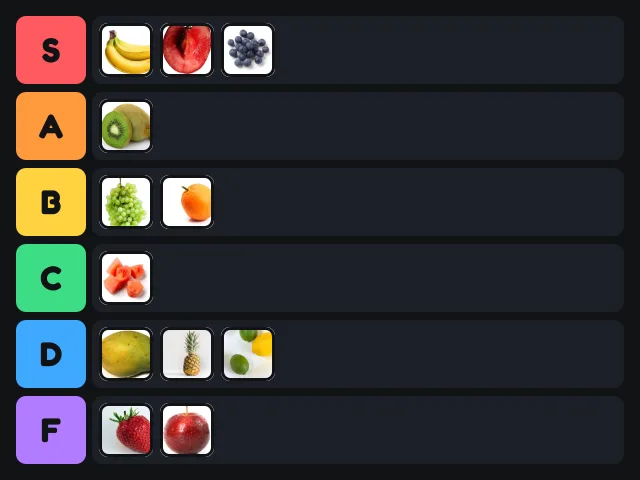
The rules
- All the items are shuffled and hidden.
- One item is revealed.
- You place it in a tier, or in a numbered slot, straight away.
- Once placed, it is locked. No moving it later.
- The next item is revealed, and so on until the deck is empty.
The fun comes from regret. Put a good item in S early and you may have nowhere for a better one that turns up later. Play it safe with A and S might stay empty.
How to play blind ranking on TierZilla
Load any board (a template, or your own cards), then press Blind ranking above the board. Every card goes back into a hidden deck in random order. The top card flips over; drag it into a tier, tap a tier on a phone, or press a tier's letter on a keyboard. It locks into place and the next card flips. When the last card lands, the round ends and you can save the result as a picture. Press Stop blind ranking at any time to put the remaining cards back in the Unranked row.
Popular variations
- Numbered blind ranking: instead of tiers, you have slots 1 to 5 or 1 to 10, and each slot takes exactly one item. To play it on TierZilla, rename the tiers to 1, 2, 3 and so on, and only put one card in each.
- Limited tiers: each tier holds a set number of cards, for example two in S, three in A. Agree on the limit before you start.
- Friend mode: two people take turns placing cards on the same board, or each plays the same deck separately and you compare the results.
- Speed round: a few seconds per card. Instinct only.
Tips for blind ranking videos
- Say the stakes out loud. Viewers enjoy hearing you worry about whether something better is still to come.
- Use a deck people know. Categories everyone has an opinion on, such as fast food, candy or pizza toppings, get the most comments.
- Keep it short. Eight to twelve items is enough for one clip.
- Show the final board. End on the finished tier list so people can screenshot it and argue. Save PNG gives you a clean image to put at the end.
Why it is harder than a normal tier list
In a normal tier list you see everything first and compare. In blind ranking you have to judge each item against what you think might still be in the deck. It tests how well you know the category, not only your taste, which is why the final boards are often very different from the ones the same person makes with all the cards in view. Try both on the same template and compare.